By: rimsha syed
Social movements throughout history that have resisted the status quo have been championed by people of color. The reproductive justice movement is no different. Black people have been at the forefront of the civil rights movement, fighting for feminism, and part of justice campaigns for the liberation of all people.
As an abortion practical support organization that values both intersectionality and equitable sexual and reproductive healthcare access, we’d be remiss not to honor Black History Month by discussing Black people’s contributions and the disparities that continue to harm them.
Black History is Reproductive Justice
The reproductive justice framework came to life in the early 90s when 12 Black women came together at a reproductive healthcare conference in Chicago, and understood the dire necessity to define bodily autonomy in a way that had never been addressed. In particular, they noticed the narrow vision of the reproductive rights movement that existed at the time which failed to address the lived experiences of Black people.
This framework was also coined in response to a Clinton administration healthcare reform agenda that did not serve marginalized communities, failing to address structural issues like poverty, lack of insurance, and racial discrimination. Thus, leading to the realization that those most harmed by healthcare inequity, medical negligence, and systemic racism should build grassroots movements for themselves. Even in its earliest stages, Black women’s reproductive activism reverberated within local and national advocacy efforts.
A few years later, 16 different organizations unified under the Sistersong Women of Color Reproductive Justice Collective to foster a national, multi-ethnic organization dedicated to fighting for abortion access and all other reproductive rights. Part of their mission focuses on normalizing reproductive justice as more than just abortion access.
“Women of color and other marginalized women also often have difficulty accessing: contraception, comprehensive sex education, STI prevention and care, alternative birth options, adequate prenatal and pregnancy care, domestic violence assistance, adequate wages to support our families, safe homes, and so much more.” [Sistersong’s website].
The criminalization and surveillance of Black people’s pregnancies
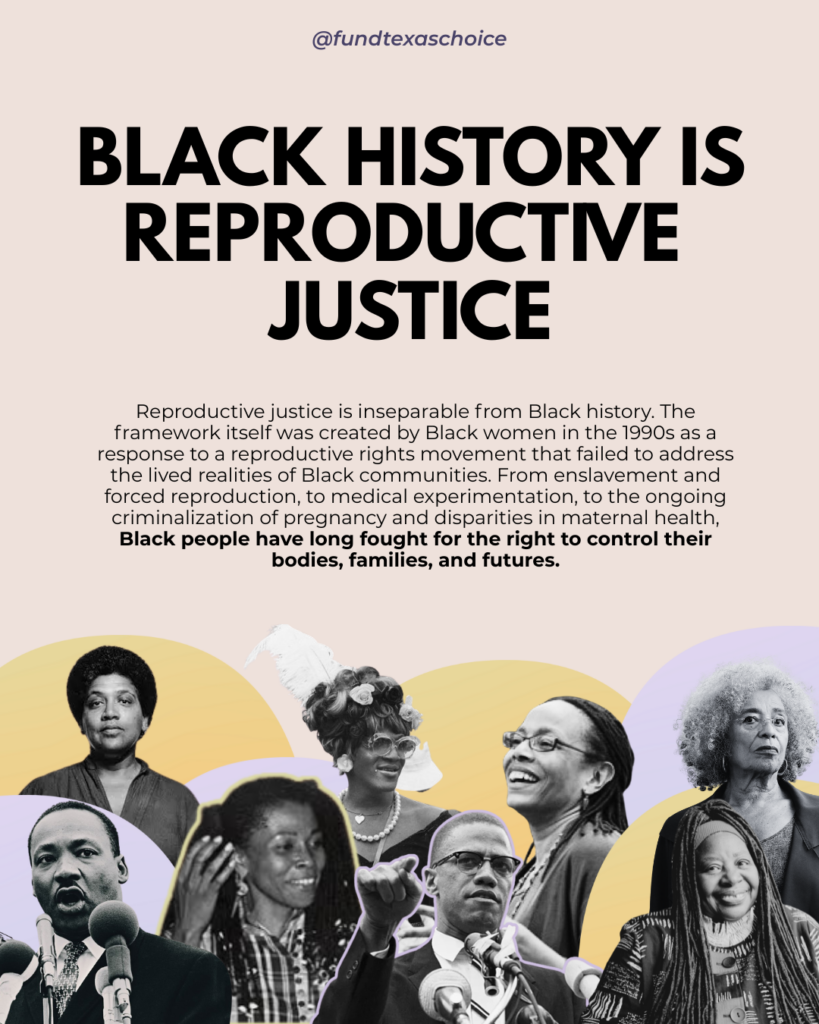
From enslavement to forced reproduction, to medical experimentation, to the ongoing criminalization of pregnancy and disparities in maternal health, Black people have long fought for the right to control their bodies, families, and futures.
Unfortunately, that fight is far from over. Many of the harmful healthcare disparities that Black people continue to face stem from slavery and unfathomable acts of cruelty.
This Reproductive Freedom Leadership Council blog explicitly ties together how “the surveillance and nonconsensual medical testing of Black women during slavery laid the foundation for ongoing reproductive criminalization, fueling the current maternal mortality crisis.” Carceral practices against pregnant women of color erupted in the 1980s and 1990s during the “war on drugs” era. In fact, it’s noted that Black women were reported to law enforcement and social services 10 times more often than white women.
Fund Texas Choice has been around for over 12 years, filling in critical gaps to support Texans’ access to abortion care. In doing so, we’ve witnessed the disproportionate impacts abortion bans have had on Black and other marginalized people, dating back to Senate Bill 8 (SB8) – more commonly known as the Six-week ban. When SB8 passed in 2022, Fund Texas Choice’s clients who identified as Black, Indigenous, or a person of color (BIPOC) increased by 13%. In 2025 alone, 83% of our clients identified as BIPOC. And according to the Texas Tribune, Black Texans have consistently had the highest rates of abortion.
When we consider these statistics and compare them to the reality that Black people are more likely to die from pregnancy or childbirth, we see that the reproductive oppression of Black people’s bodies is deeply rooted in our legal and medical landscape alike.
Several studies have concluded that Texas is one of the deadliest places in the U.S. for Black people to give birth. The maternal health complications throughout Black people’s pregnancy have and continue to be fatal – Black people are three times more likely to experience a pregnancy-related death than white people – 80% of which are preventable.
Although medical racism has caused preventable harm for decades, it’s relevant to note that maternal mortality cases in Texas rose by 56% from 2019 to 2022 as a direct result of SB 8 and, later, the overturning of Roe v Wade. Subsequently, Black people in Texas and states with strict abortion laws are far less likely to receive any prenatal care or even find an appointment with an OB-GYN.

The ongoing struggle for equitable abortion access
It is incumbent upon abortion and practical support funds to acknowledge the legacy of Black-led activism that has given us the tools and language to champion reproductive advocacy. Black History Month serves as a powerful reminder of the ongoing need for systemic change. By being cognizant of the communities who face the harshest repercussions of abortion bans and medical neglect, we can work towards a future that centers true bodily autonomy.
At Fund Texas Choice, we are eternally grateful to Black women and advocates who’ve paved the way forward. As we honor these legacies, we must also keep working to dismantle systems of oppression. Part of that looks like tapping into community-led practical support networks, like ours, standing up and raising your voice, challenging stigma, boldly calling out racism, and staying informed.
Achieving reproductive justice is essential to Black and global liberation.
Black-Led Reproductive Advocacy Organizations
As we continue to advocate for just and equitable abortion access in Texas, it’s equally important to be cognizant of the barriers that continue to persist for Black people. Here are some organizations to look into:
- SisterSong is the largest national multi-ethnic reproductive justice collective.
- Black Mamas Matter Alliance serves as a national entity working to advance Black maternal health, rights, and justice, and uplifts the work of locally based, Black women-led maternal health initiatives and organizations.
- New Voices for Reproductive Justice is an unapologetically Black and queer-led movement organization dedicated to advancing reproductive justice.
- National Black Midwives Alliance aims to increase the number of Black midwives and access to Black midwives so that there are more providers who can impact perinatal health disparities.
- Birth in Color offers community-based doula training.
- Southern Birth Justice Network strives to make midwifery and doula care accessible to all birthing people, especially POC and LGBTQ+ communities.
- MamaSana Vibrant Women provides free holistic pregnancy, birth, and postpartum support to people of color.
Responses